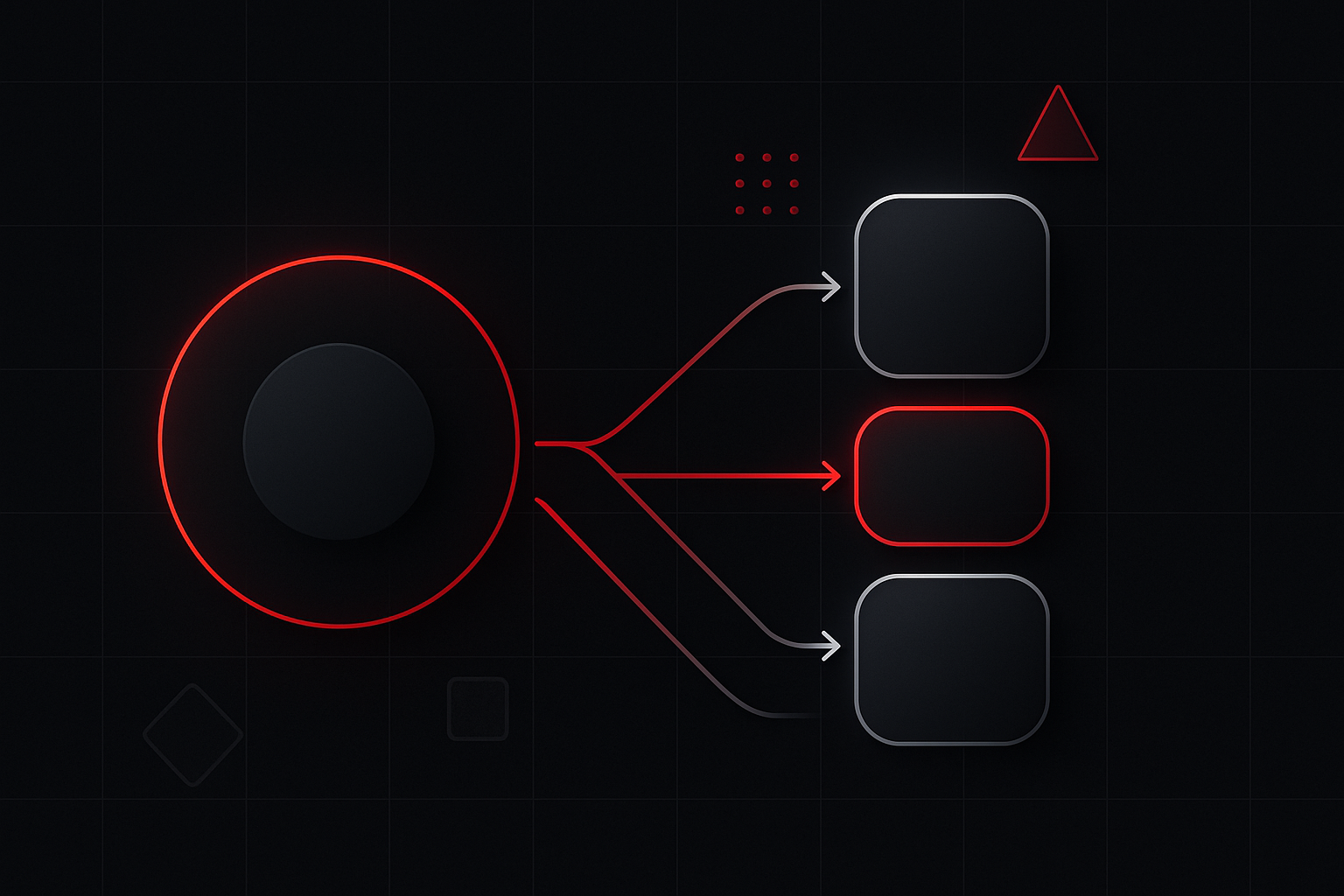
You're running a customer support platform that handles everything from "what's your return policy?" to "can you help me debug this Python exception in my API integration?" Routing both questions through GPT-4o costs you a fortune and introduces unnecessary latency. Routing both through a lightweight model produces embarrassing results on the complex ones. What you actually need is a system that makes the right call at runtime — cheaply, correctly, and fast enough that users never notice the machinery behind it.
That system is an LLM router. Not a prompt template. Not a chain. A production-grade routing layer that evaluates each incoming request against a set of configurable policies and dispatches it to the most appropriate model. Done well, routing can cut your inference spend by 40–70% while maintaining or even improving quality on the requests that matter. Done poorly, it introduces subtle failure modes that are harder to debug than just using the wrong model in the first place.
By the end of this lesson you'll have built a complete router from scratch — including complexity classification, cost and latency modeling, a policy engine, fallback logic, and an observability layer. We're going to get into the internals, the edge cases, and the production failure modes that most tutorials gloss over.
What you'll learn:
You should be comfortable with:
asyncio, aiohttp)Before writing a line of code, let's be precise about what a router is and isn't. A router is a decision-making layer that sits between your application and your LLM backends. It receives a request, evaluates it against a policy, and dispatches it to the most appropriate model — potentially with request transformation along the way.
What makes routing hard isn't the dispatch itself. It's the classification problem upstream of dispatch, and the failure handling downstream of it. You need to make a routing decision before you've seen the response, which means you're predicting task complexity from the request alone. You need to do this fast enough that it doesn't negate the latency savings of using a cheaper model. And you need to handle the cases where your prediction is wrong.
Let's establish the taxonomy of signals a router can use:
Static signals — Derived from the request structure without any model inference:
Lightweight inference signals — Derived from a small, fast classification model:
Policy signals — External to the request content:
The smartest routers combine all three. We'll build a system that does exactly that.
Good architecture starts with good data models. Let's define the core types that everything else will build on.
from __future__ import annotations
from dataclasses import dataclass, field
from enum import Enum
from typing import Optional
import time
import uuid

class ModelTier(str, Enum):
    MICRO = "micro"      # e.g., gpt-4o-mini, claude-haiku
    STANDARD = "standard"  # e.g., gpt-4o, claude-sonnet
    PREMIUM = "premium"    # e.g., o1, claude-opus

class TaskComplexity(str, Enum):
    LOW = "low"
    MEDIUM = "medium"
    HIGH = "high"
    UNKNOWN = "unknown"

@dataclass
class ModelBackend:
    model_id: str
    tier: ModelTier
    provider: str  # "openai", "anthropic", "cohere", etc.
    cost_per_input_token: float   # USD per token
    cost_per_output_token: float
    p50_latency_ms: float         # Empirically measured
    p95_latency_ms: float
    max_context_tokens: int
    supports_functions: bool = False
    supports_vision: bool = False
    weight: float = 1.0           # For load balancing within tier

@dataclass
class RoutingRequest:
    request_id: str = field(default_factory=lambda: str(uuid.uuid4()))
    messages: list[dict] = field(default_factory=list)
    user_id: Optional[str] = None
    tenant_id: Optional[str] = None

    # Constraints the caller can express
    max_cost_usd: Optional[float] = None
    max_latency_ms: Optional[float] = None
    required_capabilities: list[str] = field(default_factory=list)
    preferred_tier: Optional[ModelTier] = None

    # Computed during routing
    estimated_input_tokens: int = 0
    complexity: TaskComplexity = TaskComplexity.UNKNOWN
    complexity_confidence: float = 0.0

    created_at: float = field(default_factory=time.time)

@dataclass
class RoutingDecision:
    request_id: str
    selected_backend: ModelBackend
    routing_reason: str
    fallback_chain: list[ModelBackend] = field(default_factory=list)
    estimated_cost_usd: float = 0.0
    estimated_latency_ms: float = 0.0
    complexity_used: TaskComplexity = TaskComplexity.UNKNOWN
    decision_latency_ms: float = 0.0
Notice that RoutingDecision carries a fallback_chain. This is critical — you don't just pick a winner, you pre-compute the entire fallback sequence at decision time so that if the primary backend fails, the fallback logic doesn't need to re-run classification. We'll come back to why this matters under load.
The classifier is the heart of the router and the place where most implementations cut corners. The naive approach is to use a few heuristics — prompt length, keyword presence — and call it done. This works until it doesn't. A three-sentence prompt asking for a multi-step logical proof is "short," but it's also "hard."
We'll use a two-stage approach: fast heuristics that catch obvious cases, followed by a lightweight embedding-based classifier for the ambiguous middle.
import re
import tiktoken
from typing import NamedTuple

class ComplexitySignals(NamedTuple):
    token_count: int
    has_code_block: bool
    has_structured_output_request: bool
    conversation_turns: int
    reasoning_keyword_count: int
    domain_specificity_score: float

REASONING_KEYWORDS = {
    "analyze", "compare", "evaluate", "synthesize", "derive", "prove",
    "explain why", "step by step", "reason through", "debug", "refactor",
    "architect", "optimize", "trade-off", "implications"
}

DOMAIN_SPECIFIC_PATTERNS = [
    r'\b(def |class |import |async |await )\b',   # Code patterns
    r'\b(\d+\.\d+\.\d+)\b',                       # Version numbers
    r'\b(API|SDK|OAuth|JWT|CORS|REST|gRPC)\b',    # Technical acronyms
    r'\$[A-Z_]{2,}',                               # Environment variables
    r'```[\w]*\n',                                 # Code fences
]

def extract_complexity_signals(messages: list[dict]) -> ComplexitySignals:
    enc = tiktoken.get_encoding("cl100k_base")
    full_text = " ".join(
        m.get("content", "") for m in messages if isinstance(m.get("content"), str)
    )

    tokens = enc.encode(full_text)
    token_count = len(tokens)

    text_lower = full_text.lower()

    reasoning_count = sum(
        1 for kw in REASONING_KEYWORDS if kw in text_lower
    )

    domain_score = 0.0
    for pattern in DOMAIN_SPECIFIC_PATTERNS:
        matches = re.findall(pattern, full_text)
        domain_score += len(matches) * 0.1
    domain_score = min(domain_score, 1.0)

    has_code = "```" in full_text or bool(re.search(r'def |class |import ', full_text))
    has_structured = bool(re.search(
        r'(json|yaml|csv|table|schema|format it as|return a list)',
        text_lower
    ))

    turns = sum(1 for m in messages if m.get("role") == "user")

    return ComplexitySignals(
        token_count=token_count,
        has_code_block=has_code,
        has_structured_output_request=has_structured,
        conversation_turns=turns,
        reasoning_keyword_count=reasoning_count,
        domain_specificity_score=domain_score,
    )

def heuristic_complexity(signals: ComplexitySignals) -> tuple[TaskComplexity, float]:
    """
    Returns (complexity, confidence). High confidence means skip the embedding
    classifier and use this result directly.
    """
    # Clear low-complexity cases — high confidence
    if (signals.token_count < 150
        and not signals.has_code_block
        and signals.reasoning_keyword_count == 0
        and signals.domain_specificity_score < 0.2
        and signals.conversation_turns <= 2):
        return TaskComplexity.LOW, 0.92

    # Clear high-complexity cases — high confidence
    if (signals.token_count > 2000
        or (signals.has_code_block and signals.reasoning_keyword_count >= 2)
        or signals.reasoning_keyword_count >= 4):
        return TaskComplexity.HIGH, 0.88

    # Structured output with moderate complexity
    if signals.has_structured_output_request and signals.token_count > 400:
        return TaskComplexity.MEDIUM, 0.75

    # Ambiguous — return low confidence to trigger embedding classifier
    return TaskComplexity.MEDIUM, 0.45
The confidence score is doing real work here. When confidence is above a threshold (we'll use 0.80), we skip the embedding classifier entirely. This is what keeps routing latency in the single-digit milliseconds for the majority of requests.
For ambiguous cases, we use a small embedding model and a pre-labeled reference set. The idea is simple: embed the incoming prompt, find the nearest neighbors from our labeled examples, and vote on complexity.
import numpy as np
from openai import AsyncOpenAI

class EmbeddingClassifier:
    def __init__(self, openai_client: AsyncOpenAI):
        self.client = openai_client
        self.reference_embeddings: np.ndarray | None = None
        self.reference_labels: list[TaskComplexity] = []
        self.embedding_model = "text-embedding-3-small"  # Fast, cheap, good enough

    async def load_reference_set(self, examples: list[tuple[str, TaskComplexity]]):
        """
        examples: list of (prompt_text, complexity_label) tuples.
        Build this from your production logs — label ~200 examples per tier.
        """
        texts = [ex[0] for ex in examples]
        self.reference_labels = [ex[1] for ex in examples]

        # Batch embed — embedding models are fast, ~50ms for 200 texts
        response = await self.client.embeddings.create(
            model=self.embedding_model,
            input=texts
        )

        self.reference_embeddings = np.array(
            [item.embedding for item in response.data]
        )
        # L2-normalize for cosine similarity via dot product
        norms = np.linalg.norm(self.reference_embeddings, axis=1, keepdims=True)
        self.reference_embeddings = self.reference_embeddings / norms

    async def classify(
        self,
        messages: list[dict],
        top_k: int = 7
    ) -> tuple[TaskComplexity, float]:
        # Extract the last user message for embedding — full context is overkill here
        query_text = next(
            (m["content"] for m in reversed(messages) if m.get("role") == "user"),
            ""
        )

        response = await self.client.embeddings.create(
            model=self.embedding_model,
            input=[query_text]
        )

        query_vec = np.array(response.data[0].embedding)
        query_vec = query_vec / np.linalg.norm(query_vec)

        # Cosine similarities via dot product (vectors are normalized)
        similarities = self.reference_embeddings @ query_vec
        top_indices = np.argsort(similarities)[-top_k:][::-1]

        # Weighted vote by similarity score
        votes: dict[TaskComplexity, float] = {}
        for idx in top_indices:
            label = self.reference_labels[idx]
            score = float(similarities[idx])
            votes[label] = votes.get(label, 0.0) + score

        best_label = max(votes, key=lambda k: votes[k])
        total_score = sum(votes.values())
        confidence = votes[best_label] / total_score if total_score > 0 else 0.5

        return best_label, confidence
Production tip: Don't embed the entire conversation. Embedding only the last user turn is usually sufficient for complexity classification and cuts embedding latency by 60–80% on long conversations. The exception is when the complexity is inherently multi-turn (e.g., "given everything we've discussed, write a formal proposal") — detect this with a simple pattern match on the latest message.
With complexity classified, we need to translate that into a model selection decision. This is where cost and latency constraints enter the picture.
from pydantic import BaseModel
from typing import Callable

class RoutingPolicy(BaseModel):
    name: str

    # Complexity → tier mapping
    complexity_tier_map: dict[str, str] = {
        "low": "micro",
        "medium": "standard",
        "high": "premium",
        "unknown": "standard",  # Safe default
    }

    # Hard cost/latency gates
    max_cost_usd_override: Optional[float] = None
    max_latency_ms_override: Optional[float] = None

    # Classifier confidence threshold — below this, upgrade one tier
    min_confidence_to_downgrade: float = 0.75

    # Whether to respect caller-specified constraints
    allow_caller_cost_override: bool = True
    allow_caller_latency_override: bool = True

class PolicyEngine:
    def __init__(
        self,
        backends: list[ModelBackend],
        default_policy: RoutingPolicy,
        tenant_policies: dict[str, RoutingPolicy] | None = None
    ):
        self.backends = backends
        self.default_policy = default_policy
        self.tenant_policies = tenant_policies or {}

        # Pre-index backends by tier for O(1) lookup
        self._tier_index: dict[ModelTier, list[ModelBackend]] = {}
        for b in backends:
            self._tier_index.setdefault(b.tier, []).append(b)

    def _get_policy(self, request: RoutingRequest) -> RoutingPolicy:
        if request.tenant_id and request.tenant_id in self.tenant_policies:
            return self.tenant_policies[request.tenant_id]
        return self.default_policy

    def _select_from_tier(
        self,
        tier: ModelTier,
        request: RoutingRequest
    ) -> list[ModelBackend]:
        """
        Returns ordered list of candidates from a tier, filtering by
        capability requirements and cost/latency constraints.
        """
        candidates = self._tier_index.get(tier, [])

        # Filter by required capabilities
        if "vision" in request.required_capabilities:
            candidates = [c for c in candidates if c.supports_vision]
        if "functions" in request.required_capabilities:
            candidates = [c for c in candidates if c.supports_functions]

        # Filter by context window
        if request.estimated_input_tokens > 0:
            candidates = [
                c for c in candidates
                if c.max_context_tokens >= request.estimated_input_tokens * 1.2
            ]

        # Filter by cost constraint
        effective_max_cost = None
        if request.max_cost_usd is not None:
            effective_max_cost = request.max_cost_usd

        if effective_max_cost is not None:
            # Estimate cost: assume output is ~40% of input tokens (conservative)
            estimated_output = request.estimated_input_tokens * 0.4
            candidates = [
                c for c in candidates
                if (c.cost_per_input_token * request.estimated_input_tokens +
                    c.cost_per_output_token * estimated_output) <= effective_max_cost
            ]

        # Filter by latency constraint
        effective_max_latency = request.max_latency_ms
        if effective_max_latency is not None:
            candidates = [
                c for c in candidates
                if c.p95_latency_ms <= effective_max_latency
            ]

        # Sort by weight (allows you to do weighted random within tier)
        candidates.sort(key=lambda c: c.weight, reverse=True)
        return candidates

    def decide(self, request: RoutingRequest) -> RoutingDecision | None:
        policy = self._get_policy(request)
        start_time = time.time()

        # Determine target tier from complexity
        tier_name = policy.complexity_tier_map.get(
            request.complexity.value, "standard"
        )
        target_tier = ModelTier(tier_name)

        # If classifier confidence is low, upgrade one tier to be safe
        if request.complexity_confidence < policy.min_confidence_to_downgrade:
            tier_order = [ModelTier.MICRO, ModelTier.STANDARD, ModelTier.PREMIUM]
            current_idx = tier_order.index(target_tier)
            if current_idx < len(tier_order) - 1:
                target_tier = tier_order[current_idx + 1]

        # Respect explicit caller preference
        if request.preferred_tier is not None:
            target_tier = request.preferred_tier

        # Build fallback chain: try target tier, then upgrade, never downgrade
        tier_order = [ModelTier.MICRO, ModelTier.STANDARD, ModelTier.PREMIUM]
        target_idx = tier_order.index(target_tier)
        fallback_tiers = tier_order[target_idx:]

        primary: ModelBackend | None = None
        fallback_chain: list[ModelBackend] = []

        for tier in fallback_tiers:
            candidates = self._select_from_tier(tier, request)
            for candidate in candidates:
                if primary is None:
                    primary = candidate
                else:
                    fallback_chain.append(candidate)

        if primary is None:
            return None  # No viable backend found

        # Estimate cost
        est_output = request.estimated_input_tokens * 0.4
        est_cost = (
            primary.cost_per_input_token * request.estimated_input_tokens +
            primary.cost_per_output_token * est_output
        )

        decision_ms = (time.time() - start_time) * 1000

        return RoutingDecision(
            request_id=request.request_id,
            selected_backend=primary,
            routing_reason=f"complexity={request.complexity.value}, "
                          f"confidence={request.complexity_confidence:.2f}, "
                          f"tier={target_tier.value}",
            fallback_chain=fallback_chain,
            estimated_cost_usd=est_cost,
            estimated_latency_ms=primary.p50_latency_ms,
            complexity_used=request.complexity,
            decision_latency_ms=decision_ms,
        )
Routing decisions mean nothing if you can't execute them reliably. Production LLM APIs fail. They rate-limit, they time out, they return 503s during deployments. Your fallback chain needs to execute automatically, and you need circuit breakers to avoid hammering a backend that's already struggling.
import asyncio
from collections import deque
from enum import auto

class CircuitState(Enum):
    CLOSED = auto()    # Normal operation
    OPEN = auto()      # Backend failing, reject fast
    HALF_OPEN = auto() # Probing to see if backend recovered

class CircuitBreaker:
    def __init__(
        self,
        failure_threshold: int = 5,
        success_threshold: int = 2,
        timeout_seconds: float = 60.0,
        window_size: int = 20
    ):
        self.failure_threshold = failure_threshold
        self.success_threshold = success_threshold
        self.timeout_seconds = timeout_seconds
        self.state = CircuitState.CLOSED
        self.failure_count = 0
        self.success_count = 0
        self.last_failure_time: float = 0.0
        self.recent_results: deque[bool] = deque(maxlen=window_size)

    def record_success(self):
        self.recent_results.append(True)
        if self.state == CircuitState.HALF_OPEN:
            self.success_count += 1
            if self.success_count >= self.success_threshold:
                self.state = CircuitState.CLOSED
                self.failure_count = 0
                self.success_count = 0

    def record_failure(self):
        self.recent_results.append(False)
        self.failure_count += 1
        self.last_failure_time = time.time()

        if self.state == CircuitState.HALF_OPEN:
            self.state = CircuitState.OPEN
            self.success_count = 0
        elif self.failure_count >= self.failure_threshold:
            self.state = CircuitState.OPEN

    def is_available(self) -> bool:
        if self.state == CircuitState.CLOSED:
            return True
        if self.state == CircuitState.OPEN:
            if time.time() - self.last_failure_time > self.timeout_seconds:
                self.state = CircuitState.HALF_OPEN
                self.success_count = 0
                return True  # Allow one probe request through
            return False
        # HALF_OPEN: allow through but monitor
        return True

    @property
    def error_rate(self) -> float:
        if not self.recent_results:
            return 0.0
        return 1.0 - (sum(self.recent_results) / len(self.recent_results))
Now let's wire together the dispatch layer that actually executes the fallback chain:
import aiohttp
from openai import AsyncOpenAI, APIStatusError, APITimeoutError

class LLMDispatcher:
    def __init__(
        self,
        openai_client: AsyncOpenAI,
        circuit_breakers: dict[str, CircuitBreaker] | None = None,
        request_timeout_seconds: float = 30.0,
    ):
        self.openai_client = openai_client
        self.circuit_breakers = circuit_breakers or {}
        self.request_timeout = request_timeout_seconds

    def _get_circuit_breaker(self, backend: ModelBackend) -> CircuitBreaker:
        if backend.model_id not in self.circuit_breakers:
            self.circuit_breakers[backend.model_id] = CircuitBreaker()
        return self.circuit_breakers[backend.model_id]

    async def _call_backend(
        self,
        backend: ModelBackend,
        messages: list[dict],
        **kwargs
    ) -> dict:
        """
        Actual API call. Returns a normalized response dict.
        Real implementation would have provider-specific adapters.
        """
        if backend.provider == "openai":
            response = await asyncio.wait_for(
                self.openai_client.chat.completions.create(
                    model=backend.model_id,
                    messages=messages,
                    **kwargs
                ),
                timeout=self.request_timeout
            )
            return {
                "content": response.choices[0].message.content,
                "model": response.model,
                "usage": {
                    "prompt_tokens": response.usage.prompt_tokens,
                    "completion_tokens": response.usage.completion_tokens,
                }
            }
        raise ValueError(f"Unsupported provider: {backend.provider}")

    async def dispatch(
        self,
        decision: RoutingDecision,
        messages: list[dict],
        **kwargs
    ) -> tuple[dict, ModelBackend]:
        """
        Returns (response, actual_backend_used).
        Tries primary, then fallback chain in order.
        """
        backends_to_try = [decision.selected_backend] + decision.fallback_chain
        last_error: Exception | None = None

        for backend in backends_to_try:
            cb = self._get_circuit_breaker(backend)

            if not cb.is_available():
                # Circuit is open — skip this backend, try next
                continue

            try:
                result = await self._call_backend(backend, messages, **kwargs)
                cb.record_success()
                return result, backend

            except APITimeoutError as e:
                cb.record_failure()
                last_error = e
                # Timeouts are worth retrying on next backend immediately
                continue

            except APIStatusError as e:
                if e.status_code in (429, 503, 502):
                    # Rate limit or service unavailable — try fallback
                    cb.record_failure()
                    last_error = e
                    continue
                elif e.status_code in (400, 401, 403):
                    # Client errors — don't try fallbacks, fail fast
                    cb.record_success()  # Not the backend's fault
                    raise
                else:
                    cb.record_failure()
                    last_error = e
                    continue

        raise RuntimeError(
            f"All backends exhausted for request {decision.request_id}. "
            f"Last error: {last_error}"
        )
Warning: Notice that we don't record circuit breaker failures on 400/401/403 errors. These are client-side errors — the backend is healthy, your request is malformed. Naively recording all errors as backend failures will open circuit breakers incorrectly and route requests to backends that can't handle them either.
Now we bring everything together into a single LLMRouter class with a clean interface:
class LLMRouter:
    def __init__(
        self,
        backends: list[ModelBackend],
        policy: RoutingPolicy,
        openai_client: AsyncOpenAI,
        confidence_threshold: float = 0.80,
        tenant_policies: dict[str, RoutingPolicy] | None = None,
    ):
        self.classifier_embeddings = EmbeddingClassifier(openai_client)
        self.policy_engine = PolicyEngine(backends, policy, tenant_policies)
        self.dispatcher = LLMDispatcher(openai_client)
        self.confidence_threshold = confidence_threshold
        self._metrics: list[dict] = []  # In production, use a real metrics sink

    async def route_and_complete(
        self,
        messages: list[dict],
        user_id: str | None = None,
        tenant_id: str | None = None,
        max_cost_usd: float | None = None,
        max_latency_ms: float | None = None,
        required_capabilities: list[str] | None = None,
        **completion_kwargs
    ) -> dict:

        request = RoutingRequest(
            messages=messages,
            user_id=user_id,
            tenant_id=tenant_id,
            max_cost_usd=max_cost_usd,
            max_latency_ms=max_latency_ms,
            required_capabilities=required_capabilities or [],
        )

        # Stage 1: Token count (always fast)
        signals = extract_complexity_signals(messages)
        request.estimated_input_tokens = signals.token_count

        # Stage 2: Heuristic classification
        complexity, confidence = heuristic_complexity(signals)

        # Stage 3: Embedding classification only if confidence is low
        if confidence < self.confidence_threshold:
            try:
                complexity, confidence = await self.classifier_embeddings.classify(
                    messages
                )
            except Exception:
                # Embedding call failed — use heuristic result, upgrade tier
                confidence = min(confidence, 0.50)

        request.complexity = complexity
        request.complexity_confidence = confidence

        # Stage 4: Policy decision
        decision = self.policy_engine.decide(request)
        if decision is None:
            raise RuntimeError("No viable backend available given constraints")

        # Stage 5: Dispatch with fallback
        dispatch_start = time.time()
        response, actual_backend = await self.dispatcher.dispatch(
            decision, messages, **completion_kwargs
        )
        dispatch_ms = (time.time() - dispatch_start) * 1000

        # Stage 6: Record metrics
        self._record_metric(request, decision, actual_backend, dispatch_ms, response)

        return response

    def _record_metric(
        self,
        request: RoutingRequest,
        decision: RoutingDecision,
        actual_backend: ModelBackend,
        dispatch_ms: float,
        response: dict,
    ):
        usage = response.get("usage", {})
        actual_cost = (
            actual_backend.cost_per_input_token * usage.get("prompt_tokens", 0) +
            actual_backend.cost_per_output_token * usage.get("completion_tokens", 0)
        )

        self._metrics.append({
            "request_id": request.request_id,
            "tenant_id": request.tenant_id,
            "complexity": request.complexity.value,
            "confidence": request.complexity_confidence,
            "planned_model": decision.selected_backend.model_id,
            "actual_model": actual_backend.model_id,
            "fallback_used": actual_backend.model_id != decision.selected_backend.model_id,
            "estimated_cost": decision.estimated_cost_usd,
            "actual_cost": actual_cost,
            "dispatch_latency_ms": dispatch_ms,
            "decision_latency_ms": decision.decision_latency_ms,
            "prompt_tokens": usage.get("prompt_tokens", 0),
            "completion_tokens": usage.get("completion_tokens", 0),
        })
For multi-tenant SaaS applications, you need per-tenant budget enforcement, not just per-request constraints. Let's add a Redis-backed budget manager that tracks spend in a rolling window.
import redis.asyncio as aioredis
import json

class BudgetManager:
    def __init__(self, redis_client: aioredis.Redis, window_seconds: int = 3600):
        self.redis = redis_client
        self.window = window_seconds

    async def get_remaining_budget(
        self,
        tenant_id: str,
        budget_usd: float
    ) -> float:
        key = f"budget:{tenant_id}:{int(time.time() // self.window)}"
        spent_raw = await self.redis.get(key)
        spent = float(spent_raw) if spent_raw else 0.0
        return max(0.0, budget_usd - spent)

    async def record_spend(self, tenant_id: str, cost_usd: float):
        key = f"budget:{tenant_id}:{int(time.time() // self.window)}"
        pipe = self.redis.pipeline()
        pipe.incrbyfloat(key, cost_usd)
        pipe.expire(key, self.window * 2)  # Keep for 2 windows for debugging
        await pipe.execute()

    async def check_and_reserve(
        self,
        tenant_id: str,
        estimated_cost: float,
        budget_usd: float
    ) -> bool:
        """
        Atomic check-and-reserve. Returns True if budget is available.
        Uses a Lua script to make this atomic in Redis.
        """
        lua_script = """
        local key = KEYS[1]
        local budget = tonumber(ARGV[1])
        local cost = tonumber(ARGV[2])
        local ttl = tonumber(ARGV[3])

        local current = tonumber(redis.call('GET', key)) or 0
        if current + cost > budget then
            return 0
        end
        redis.call('INCRBYFLOAT', key, cost)
        redis.call('EXPIRE', key, ttl)
        return 1
        """
        key = f"budget:{tenant_id}:{int(time.time() // self.window)}"
        result = await self.redis.eval(
            lua_script, 1, key, budget_usd, estimated_cost, self.window * 2
        )
        return bool(result)
Architecture note: The atomic Lua script is not optional here. Without it, you have a race condition under concurrent requests for the same tenant — two requests can both read "budget available," both proceed, and together exceed the limit. Redis Lua scripts execute atomically, solving this at the cost of slightly higher Redis latency (~1-2ms). This is almost always the right trade-off.
A router you can't observe is a router you can't improve. The most valuable signal is the delta between your complexity prediction and actual quality outcomes — but that requires a feedback loop from your evaluation system. Here's what to instrument, even before you have that loop:
from dataclasses import dataclass, asdict

@dataclass
class RouterObservabilityEvent:
    # Routing metadata
    request_id: str
    timestamp: float
    tenant_id: str | None

    # Classification
    heuristic_complexity: str
    heuristic_confidence: float
    embedding_classifier_used: bool
    final_complexity: str
    final_confidence: float

    # Decision
    target_tier: str
    selected_model: str
    fallback_triggered: bool
    actual_model_used: str

    # Economics
    estimated_cost_usd: float
    actual_cost_usd: float
    cost_estimation_error_pct: float

    # Performance
    decision_latency_ms: float
    embedding_latency_ms: float
    total_dispatch_latency_ms: float

    # Quality signals (filled in async via eval pipeline)
    user_satisfaction_score: float | None = None
    quality_eval_score: float | None = None
    required_retry: bool = False

async def emit_to_datawarehouse(event: RouterObservabilityEvent, sink):
    """
    In production, this goes to BigQuery, Snowflake, or ClickHouse.
    The key is that every routing decision is a row you can analyze.
    """
    await sink.write(asdict(event))
The metric that tells you most about routing quality is cost_estimation_error_pct. If you're consistently underestimating output length for certain task types, you'll be routing them to cheaper models than intended. Track this by complexity class and you'll quickly find systematic biases.
Another critical metric: track the fallback_triggered rate by backend. If a specific model is triggering fallbacks more than 5% of the time, you either have a reliability problem with that provider or your circuit breaker thresholds need tuning.
Set up a working router instance and run it against a varied test suite. Here's your exercise scaffold:
import asyncio
from openai import AsyncOpenAI

async def exercise_main():
    client = AsyncOpenAI()  # Set OPENAI_API_KEY in environment

    backends = [
        ModelBackend(
            model_id="gpt-4o-mini",
            tier=ModelTier.MICRO,
            provider="openai",
            cost_per_input_token=0.00000015,
            cost_per_output_token=0.0000006,
            p50_latency_ms=400,
            p95_latency_ms=1200,
            max_context_tokens=128000,
            supports_functions=True,
        ),
        ModelBackend(
            model_id="gpt-4o",
            tier=ModelTier.STANDARD,
            provider="openai",
            cost_per_input_token=0.0000025,
            cost_per_output_token=0.00001,
            p50_latency_ms=800,
            p95_latency_ms=3000,
            max_context_tokens=128000,
            supports_functions=True,
            supports_vision=True,
        ),
    ]

    policy = RoutingPolicy(name="default")

    router = LLMRouter(
        backends=backends,
        policy=policy,
        openai_client=client,
    )

    # Test cases — vary dramatically in complexity
    test_cases = [
        # Should route to micro
        {"messages": [{"role": "user", "content": "What is the capital of France?"}]},

        # Should route to micro
        {"messages": [{"role": "user", "content": "Translate 'good morning' to Spanish."}]},

        # Should route to standard
        {"messages": [{"role": "user", "content":
            "Compare the trade-offs between PostgreSQL and MongoDB for "
            "a multi-tenant SaaS application with variable schema requirements "
            "and high read throughput. Consider indexing, consistency, and "
            "operational complexity."}]},

        # Should route to standard/premium
        {"messages": [{"role": "user", "content":
            "Here's a Python function that's causing intermittent deadlocks "
            "in our async worker pool:\n```python\n"
            "async def process_batch(items):\n"
            "    lock = asyncio.Lock()\n"
            "    async with lock:\n"
            "        results = await asyncio.gather(*[process_item(i) for i in items])\n"
            "    return results\n```\n"
            "Analyze why this causes deadlocks, explain the exact failure mode, "
            "and provide a corrected implementation with explanation."}]},
    ]

    for i, test in enumerate(test_cases):
        print(f"\n--- Test {i+1} ---")
        print(f"Prompt: {test['messages'][0]['content'][:80]}...")

        response = await router.route_and_complete(**test)

        metric = router._metrics[-1]
        print(f"Routed to: {metric['actual_model']}")
        print(f"Complexity: {metric['complexity']} (confidence: {metric['confidence']:.2f})")
        print(f"Actual cost: ${metric['actual_cost']:.6f}")
        print(f"Dispatch latency: {metric['dispatch_latency_ms']:.0f}ms")
        print(f"Response: {response['content'][:120]}...")

asyncio.run(exercise_main())
Exercise extensions to try:
RoutingPolicy to set min_confidence_to_downgrade = 0.95 and observe how more requests get upgraded to the next tier.circuit_breakers["gpt-4o-mini"].state = CircuitState.OPEN and verify that requests fall through to the standard tier.Token count is a proxy for complexity, not a measure of it. A 10-token prompt asking "Prove the Riemann Hypothesis" is trivially short but maximally hard. A 2000-token prompt that's a verbatim copy-paste of a document with the question "What's the title of this document?" is long but trivial. Always combine token count with semantic signals.
If your embedding classifier adds 80ms to every request and routing to a MICRO model saves 200ms over STANDARD, you're netting only 120ms — and that's before you account for the fact that the embedding call can fail. Profile your classifier end-to-end. The heuristic fast-path isn't optional for high-traffic systems.
Cost estimation based solely on input tokens is systematically wrong. A "low complexity" request can generate a very long output (e.g., "list all 50 US state capitals"). Track actual completion_tokens per complexity class in your observability data, compute a realistic output multiplier per task type, and feed it back into your cost model.
Your reference set for the embedding classifier needs to evolve with your traffic. If you built it six months ago and your user base has shifted toward more technical questions, your "medium complexity" cluster is miscalibrated. Schedule quarterly re-labeling sessions and track classification drift in your metrics.
Some implementations query the policy engine again on each fallback attempt. This is a latency disaster and introduces the risk of inconsistent decisions (a backend that was available when the primary call failed might now be the "primary" for the retry). Pre-compute the full fallback chain at decision time. If backend availability changes between primary and fallback calls, the circuit breaker handles it — don't re-run policy logic.
Rate limiting behavior is asymmetric across model tiers. Premium models typically have lower rate limits (requests per minute) but are less likely to throw 503s. Micro models have higher throughput limits but are more commonly rate-limited during peak hours. Tune your circuit breakers per-model, not with a single global configuration.
If you're seeing 70%+ of requests being routed to STANDARD when you expected 50%, check:
min_confidence_to_downgrade setting — lower it if the embedding classifier is consistently uncertainIf fallback_triggered rate exceeds 8% for a specific backend, investigate:
You've built a production-grade LLM router that:
The system you've built is genuinely useful as-is, but production hardening never stops. Here's where to invest next:
Immediate extensions:
quality_eval_score on observability events, then use this data to retrain the complexity thresholdsArchitecture evolutions:
The investment in routing infrastructure pays for itself quickly — at scale, the difference between "always use the best model" and "use the right model" is measured in tens of thousands of dollars per month. More importantly, it gives you a policy layer you can reason about and tune, rather than a single point of failure where one model's degradation takes down your entire product.
Learning Path: Building with LLMs